Table of Contents
Introduction
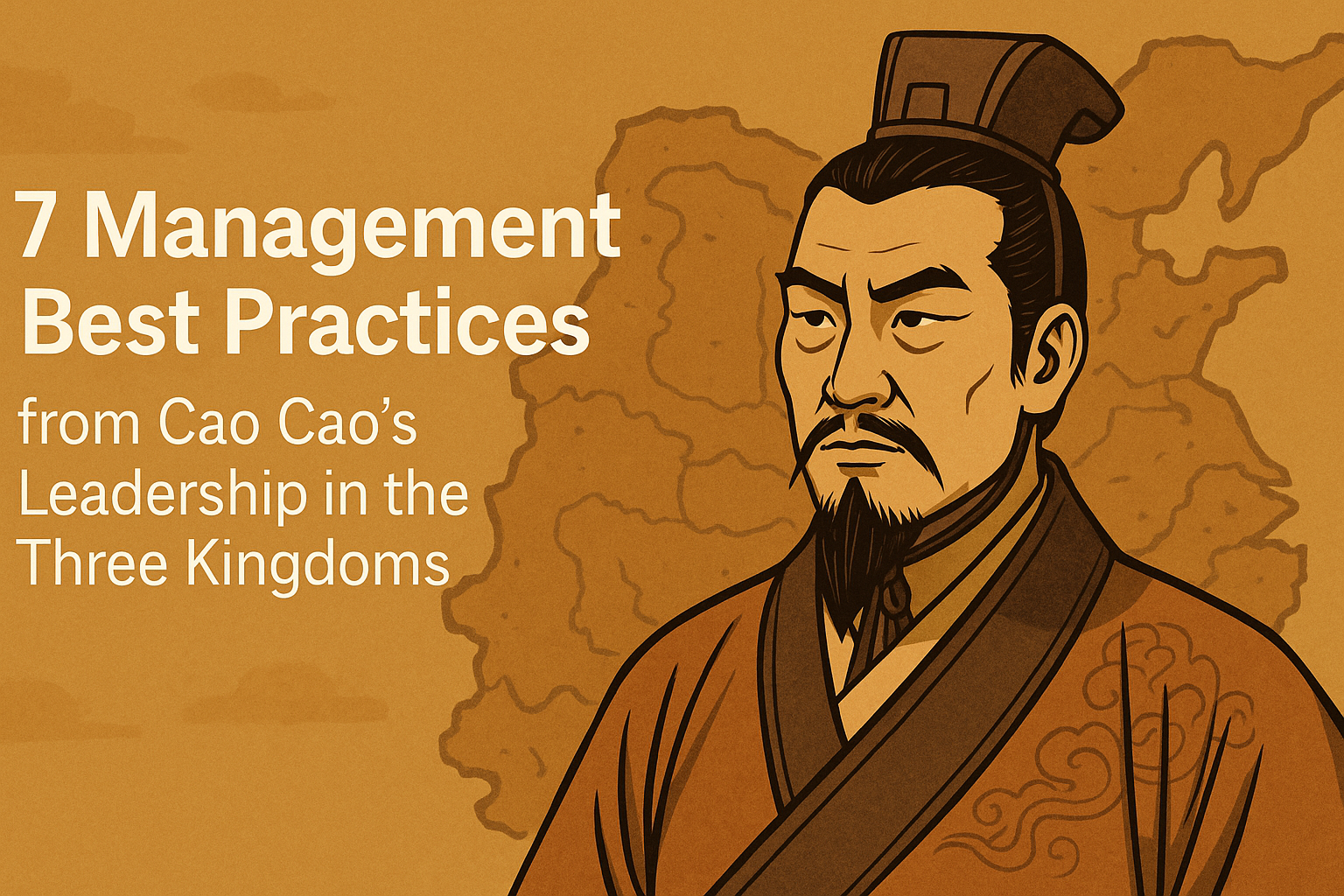
Modern management books are filled with battle metaphors, but long before corporate strategy guides were printed, leaders in ancient China were already proving how warfare and governance overlap. Few figures show this connection more vividly than Cao Cao, the warlord and statesman of the Three Kingdoms era.
At East Minds, we believe Eastern philosophy is not just about abstract wisdom or poetic sayings. It is also about the daily art of ruling, persuading, and building systems that last. Cao Cao’s story reminds us that philosophy and practice belong together, especially when the stakes are high.
By looking closely at his words and actions, managers today can uncover lessons that still apply: how to balance vision with pragmatism, how to reward talent, and how to keep discipline without crushing initiative. These practices, drawn from one of history’s most complex leaders, open a path for modern readers to rethink leadership, strategy, and team building.
Vision and Strategic Planning
Decisive Vision
Cao Cao was never shy about making hard choices. One of his most striking lines comes from Romance of the Three Kingdoms, Vol. 4:
“宁我负人,毋人负我”
“I would rather betray the world than let the world betray me.”
This bold declaration shows a leader who placed long-term survival and vision above short-term approval. In management terms, it teaches that clarity of direction sometimes demands unpopular moves. A company cannot always please everyone, but it must hold fast to the vision that keeps it alive in the long run.
Strategic Patience
Cao Cao’s greatness did not lie only in bold strokes. He also knew when to wait. According to Zizhi Tongjian, Vol. 65, he consolidated power carefully before launching his campaign against Yuan Shao. By holding back, securing resources, and strengthening alliances, he avoided rushing into a fight he was not ready to win.
The lesson for modern managers is simple but profound: timing matters as much as ambition. Just as Cao Cao resisted the urge to charge ahead without preparation, leaders today must learn when to act quickly and when to pause, build foundations, and strike only when conditions favor success.
Talent Recognition and Team Building

Meritocracy Over Birth
Cao Cao understood that a strong state could not be built on family ties alone. In Sanguozhi, Book of Wei, Biography of Cao Cao, historian Chen Shou records his guiding principle:
“唯才是举”
“Only talent should be considered.”
This short line captures a radical idea for his time. Instead of promoting people by birth or noble status, Cao Cao opened doors to anyone with ability. For modern managers, the message is clear: reward competence, not connections. Teams grow stronger when roles are given to those who can actually deliver results, no matter where they come from.
Trust and Delegation
Another mark of Cao Cao’s leadership was his ability to rely on wise advisors. The Sanguozhi, Book of Wei tells us how he leaned on figures like Xun Yu, known for his political foresight, and Guo Jia, whose strategic advice helped Cao Cao win against stronger rivals. By entrusting them with real authority, he multiplied his own power.
The lesson for today’s leaders is straightforward yet often overlooked: no one can build lasting success alone. By trusting capable lieutenants and allowing them to make decisions, leaders free themselves to focus on vision and direction. Cao Cao’s rise was not just about his brilliance but also about his talent for finding the right people and letting them shine.
Adaptability and Crisis Management
Battle of Guandu (200 CE)
When facing Yuan Shao’s massive army, Cao Cao had fewer troops and limited supplies. Yet history records how he turned weakness into strength. In Zizhi Tongjian, Vol. 65, it is written:
“操兵少而粮尽,然用计破绍于官渡。”
“Cao Cao had few soldiers and his grain was nearly exhausted, yet through strategy he defeated Yuan Shao at Guandu.”
This account highlights that victory does not always belong to the larger force. Cao Cao’s careful intelligence gathering and cunning use of deception allowed him to strike at Yuan Shao’s supply lines, flipping the battle in his favor. For modern managers, the lesson is plain: when resources are scarce, smart thinking and efficient allocation can achieve more than sheer scale.
Innovation in Agriculture
Cao Cao’s adaptability also showed in how he dealt with ongoing food shortages. Instead of relying only on traditional tax grain, he introduced the Tuntian system, where soldiers and settlers farmed state land to supply the army. The Sanguozhi, Book of Wei records:
“置屯田官,使民就田而耕,以足军粮。”
“He established officials for agricultural colonies, sending people to cultivate the fields so that the army would be supplied with grain.”
This reform ensured stability in both war and peace. Rather than chasing temporary fixes, Cao Cao created a system that turned crisis into an opportunity for sustainability. For today’s organizations, the message is powerful: true adaptability means designing long-term solutions that endure beyond the immediate emergency.
Discipline and Governance

Strict but Fair Law
Cao Cao understood that an army without discipline would destroy itself from within. He made it clear that soldiers were not free to plunder the people they were supposed to protect. In Sanguozhi, Book of Wei, Chen Shou records:
“禁军士不得扰民,犯者必诛。”
“He forbade his soldiers from disturbing the common people, and any who violated this were executed.”
Such harsh rules may sound severe, but they built trust between civilians and the military. By showing that his forces would not prey on the weak, Cao Cao earned legitimacy and strengthened the stability of his rule. For modern managers, the message is straightforward: discipline, when applied with fairness, creates credibility and a culture that others are willing to support.
Internal Order Before Expansion
Cao Cao also knew that disorder at home made outward campaigns impossible. Before launching further conquests, he concentrated on putting his administration in order and securing his base. The Zizhi Tongjian, Vol. 66 notes:
“操先治内政,然后图远略。”
“Cao Cao first put domestic affairs in order, and only then sought distant ventures.”
This principle still resonates today. An organization must strengthen its structure, processes, and culture before rushing into aggressive growth. Without internal stability, expansion becomes fragile and unsustainable. Just as Cao Cao built order before seeking new victories, leaders now must lay firm foundations before chasing bold ambitions.
Communication and Persuasion
Speeches to Soldiers
Cao Cao knew that words could move men as much as weapons. Before battle, he often appealed to his troops’ sense of justice and duty, framing their cause as morally righteous. In Romance of the Three Kingdoms, Vol. 5, we read:
“吾军所向,皆为百姓除害。”
“Wherever our army goes, it is to rid the people of harm.”
By presenting the campaign as service to the people, Cao Cao transformed fear into resolve. His soldiers fought not only for survival but also for a higher purpose. For modern managers, the lesson is timeless: when words align personal effort with a shared mission, teams become more than workers. They become believers in a cause.
Psychological Warfare
Cao Cao’s mastery of communication extended beyond his own ranks. He used words as a weapon against rivals, spreading rumors and misinformation to sow doubt. The Zizhi Tongjian, Vol. 66 records:
“操多设疑计,使敌相疑。”
“Cao Cao often devised schemes of suspicion, causing his enemies to doubt one another.”
This tactic weakened enemy unity without a single sword stroke. It shows that communication is not only for inspiring allies but also for disarming opponents. In the business world, the ethical form of this lesson is clear: influence extends past your immediate team. How you shape narratives, manage perceptions, and frame information can decide whether rivals stand strong or falter.
Conclusion
Cao Cao’s legacy is more than battlefield victories. His best practices stretched across vision, the promotion of talent, the ability to adapt in crisis, the enforcement of discipline, and the art of persuasion. Together, these qualities reveal a leader who combined sharp strategy with a deep sense of governance.
When we look at these lessons through the lens of Eastern philosophy, the parallels to modern management become striking. Ancient thought reminds us that leadership is not only about strength but also about balance. Vision must be matched with patience, rules with fairness, and words with purpose.
For today’s leaders, the challenge is to bring these pieces together. By studying Cao Cao, we learn that ambition is most powerful when anchored by order, discipline works best when joined with inspiration, and strategy finds its highest form when tempered by humanity. These are not relics of a distant past. They are timeless practices that can guide anyone seeking to lead with clarity and resilience in a complex world.